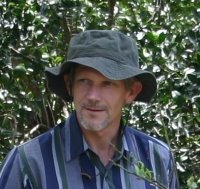
Last week I had the privilege of hiking for two days in Mt Elgon National Park, climbing from about 2050 meters above sea level to about 2,675 meters and back down to where we started. We spent the night at (partly in) Tatum (tah-TOOM) Cave at the 2,675-meter level. Of necessity our pace was faster than ideal for birding, but I did see some good ones along the way, viz.:
* Brown woodland warbler (Phylloscopus umbrovirens) -- a first for me
* Grey cuckoo-shrike (Coracina caesia)
* Hartlaub's turaco (Tauraco hartlaubi) -- first time to meet these in Uganda; have seen them several times in Kenya
* Olive pigeon (Columba arquatrix)
* White-tailed crested flycatcher (Elminia albonotata)
* African blue flycatcher (Elminia longicauda)
* Mountain buzzard (Buteo oreophilus)
* Ayres' hawk eagle (Hieraaetus ayresii)
* White-starred robin (Pogonocichla stellata) -- first time to see this in Uganda; a familiar species from Malawi years
* Olive thrush (Turdus olivaceus) -- first time to see this in Uganda; common in Kenya highlands
* Black-throated apalis (Apalis jacksoni)
We also saw a few blue monkeys and heard baboons and black-and-white colobus monkeys as we walked through the montane forest.
Monday, February 25, 2008


Tuesday, February 12, 2008
Recently noted
Several species of interest that I've spotted here and there in the past week or two:
Red-necked falcon (Falco chicquera) -- checked the borassus palm where we have been seeing one of these for the past several weeks and found it perched there again
Abyssinian roller (Coracias abyssinica) -- saw a few of these in passing while traveling in the vicinity of Soroti town
Namaqua dove (Oena capensis) -- had one fly by over wet grassland near Awoja on our way to Soroti
Giant (Verreaux's) eagle owl (Bubo lacteus) -- saw one carrying prey early the other morning, and have been hearing them more often lately than we did for a while
Black-and-white-casqued hornbill (Bycanistes subcylindricus) -- heard one of these large fellows while out running early a couple of mornings ago
African little sparrowhawk (Accipiter minullus) -- another one (second in a month) flying over
Tropical boubou (Laniarius aethiopicus) -- haven't actually seen one recently, but have been hearing them often calling (often duetting) from inside thickets in our neighborhood
Harlequin quail (Coturnix delegorguei) -- came across a female dead on the road, probably struck by a car while migrating in the night
Wednesday, January 30, 2008
African hoopoe
What a treat this morning, as I was taking the kids to school, to see an African hoopoe (Upupa africana) winging away over an undeveloped lot across from the school house! I remember seeing these handsome fellows only twice before in my twelve years in Mbale, although they are more regular elsewhere in the region (e.g., just across the mountain from us in the western Kenya highlands). Interestingly, all three sightings have been at spots within 500 meters of each other, even though separated by a couple of years, time-wise.
Saturday, January 26, 2008
Red-headed lovebird
Jonathan and I went birding early on a recent Monday in an area of moist grassland interlaced with Acacia stands (mostly falcon's claw acacia trees) and bordering a wetland, just outside Mbale town. Saw quite a few interesting species of birds, including broad-billed rollers (Eurystomus glaucurus) and green sandpipers (Tringa ochropus). But we were most pleased (and surprised) to have a close encounter with a couple of red-headed lovebirds (Agapornis pullaria). I've occasionally seen flocks of Lilian's lovebird (Agapornis lilianae), particularly in Liwonde National Park, Malawi. But this was the first time I've come across a member of this family in East Africa. These were quite confiding, and one of the pair we saw allowed us to approach fairly closely and view him at our leisure.
The red-necked falcon (Falco chicquera) that I mentioned in an earlier post has continued to hang out in the borassus palm in which I've seen it three or four times now. This strengthens my belief that a pair may be nesting there.
I have not seen the white-necked ravens (Corvus albicollis), that had been in our vicinity, for over a week now.
Friday, January 11, 2008
Nifty Mbale raptors & a few birds from around Entebbe
The past two or three weeks have been better than average for raptor sightings around Mbale. I also ran across some interesting bird species on a recent trip to Entebbe.
- European marsh harrier (Circus aeruginosus) - one female, just outside Mbale town, over a patch of wetland
- Red-necked falcon (Falco chicquera) - on two occasions I've seen a single bird on a borassus palm on the south edge of Mbale town; I speculate that there may be a pair breeding there, as I have observed a breeding pair of these attractive falcons in another borassus about three years running in the late 90s, also in Mbale town
- African little sparrowhawk (Accipiter minullus) - had one over our house engaged in what appeared to be a display flight; I have only rarely seen these particularly secretive little hawks out in the open
- Palm-nut vulture (Gypohierax angolensis) - these are resident in Mbale town, but I also had excellent views of more than one near Entebbe; the interesting thing there was that I stumbled on a "feeding station," the regular perch used by one individual for its morning meal of palm nuts (Raffia sp., I believe)
- Wahlberg's eagle (Aquila wahlbergi) - I've come to expect these in the Entebbe area, and have watched them there often enough to begin to recognize the particular soaring posture that distinguishes them from other smaller-than-average eagle species
- Red-chested cuckoo (Cuculus solitarius) - probably the commonest of the larger cuckoos, but always a striking bird; I had especially fine views of one while in the Entebbe area
- Red-shouldered cuckoo-shrike (Campephaga phoenicea) - another from my Entebbe trip, this may be the first time (at least first in many years) that I've seen a male of this species; am more accustomed to the standard black cuckoo shrike (Campephaga flava), but this red-shouldered fellow was a truly impressive sight to behold
- African penduline tit (Anthoscopus caroli) - two or three in an Entebbe garden; these diminutive avians appear thoroughly nondescript but do sport a distinctive short, sharp beak
- Red-billed oxpecker (Buphagus erythrorhynchus) - have been seeing these in Mbale the past couple of weeks or so, sometimes singly, sometimes in groups of two or three
- African spoonbill (Platalea alba) - in a wetland area just west of Mbale town; although I don't see these all that often, I suspect that they are around most of the time in small numbers, tending to roost in mixed groups of herons, egrets, storks and other aquatic birds
Sunday, January 6, 2008
Wanale thermals
An opportunity several days ago to hike Wanale mountain, the lovely backdrop to Mbale town, afforded some nifty sightings of birds taking advantage of the thermals rising at the cliffs' edge.
My favorite was an immature Ayre's hawk eagle (Hieraaetus ayresii) engaging in an impressive series of aerial maneouvres with three adult harrier hawks (Polyboroides typus).
There were also a dozen or so common (rock) kestrels (Falco tinnunculus) in evidence around the rock faces.
An interesting encounter was with a pair of white-necked ravens (Corvus albicollis) -- a common species in Malawi, but one that I have never come across in Uganda before. They were cruising along the edge of the mountain on the same thermal currents already mentioned. Since that day, I have seen this same pair (presumably) down in Mbale town scavenging refuse near a local hotel. I'll keep an eye out for them to figure out whether they're just passing through for a few days or weeks or intend to take up longer-term residence.
Speaking of ravens, one morning last week when I had observed the white-necked ravens near the hotel, I later visited Sipi Falls on Mt. Elgon and saw the fan-tailed ravens (Corvus rhipidurus) that are regular there. This was the first time that I can remember ever seeing two species of ravens in Africa in the same day.
One other raptor of special interest from the Wanale hike was a mountain buzzard (Buteo oreophilus) in flight, of which I had excellent views for ten minutes or more as we waited for others in the group to begin our descent.
Monday, December 24, 2007
Mt Elgon National Park
I have to say I'm a little sheepish about having lived in Mbale, in the shadow of Mount Elgon for almost 12 years, but not having set foot inside Mt Elgon national park until last Saturday (still haven't made it to any of the peaks, or into the caldera, the largest in the world, BTW). Nathanael, Jonathan, their friend Abraham and I loaded ourselves and our binoculars, water, and bug repellent into the pickup and left the house shortly after 7:30 Saturday morning.
It took us a couple of hours to get up the first two terraces of Mt Elgon and to the park gate, partly because we made a couple of stops along the way. One of them, about 20 km from Mbale town, was a rare and memorable occasion. I pulled over to take a closer look at a medium-sized bird of prey sharing the top of a muvuli tree with a hamerkop (Scopus umbretta). To our great delight the raptor turned out to be a peregrine falcon (Falco peregrinus). It stayed put and gave us excellent views from right under the tree from which it was taking in the morning.
Once inside the park, we hooked up with a young guide and did a 5-km circuit that took us through mostly secondary forest. There were, however, quite a number of enormous remnant giant trees from the days before the primary forest was encroached and before the park was gazetted with its current boundaries (formerly quite a number of local villagers living near the forest boundaries had cut down many of the larger trees and done some cultivation inside the park perimeter). On our way we stopped by a lovely little waterfall and a cave with a considerable bat population (the latter especially fascinating to the boys).
Our time was somewhat limited, so we hiked at about double the ideal birding pace. This limited the number of bird species that we were able to observe/identify, but still we came across several notables, including some new ones for me (I'll mark these with a double asterisk).
** montane oriole (Oriolus percivali)
** both banded / brown-throated and black-throated wattle-eyes (Platysteira cyanea and P. peltata)
** black-throated apalis (Apalis jacksoni)
** Luehder's bush-shrike (Laniarius luehderi)
** male white-phase paradise flycatcher (Terpsiphone viridis)
** African hill-babbler (Illadopsis abyssinica)
** white-tailed crested flycatcher (Elminia albonotata) -- this is an old friend with which I first became familiar in one of my favorite spots on the planet, Zomba mountain in Malawi; I'd not seen it before in Uganda
** black-faced rufous warbler (Bathmocercus rufus) -- heard these secretive birds but did not get a glimpse of them; they are familiar from many times birding in rainforest near Kakamega, Kenya
Subscribe to:
Posts (Atom)